
There, But Not There
Why presence isn’t measured in hours

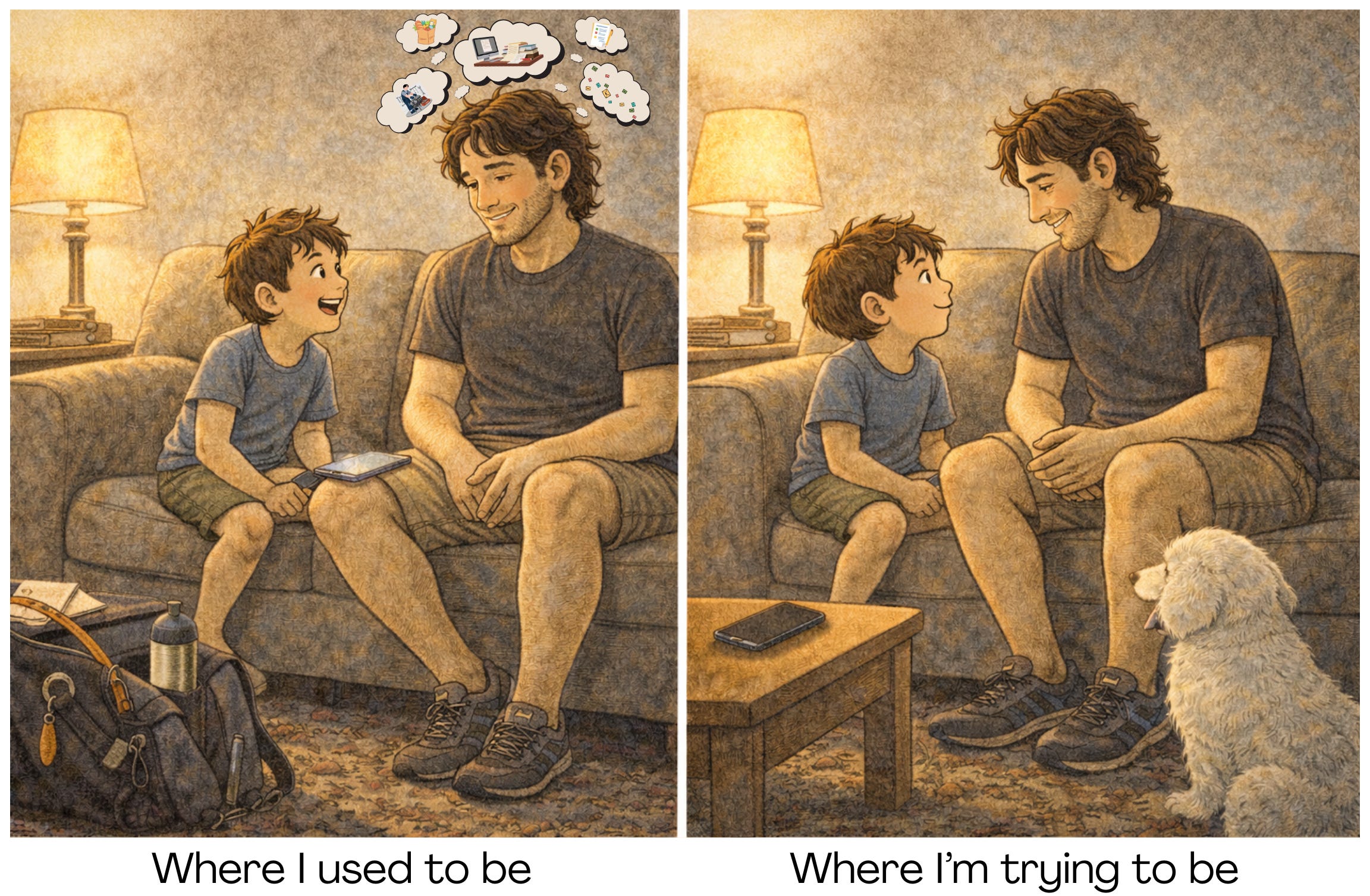
For too many years, I held onto an unwritten rule.
A good husband comes home and gives everything he has left.
A good father spends as much time as possible with his family.
A good man shows up.
So I showed up.
I came home from work and dedicated myself to being there.
Present. Available. Involved.
At least, that’s what it looked like.
But something was off.
There… but not really there
I was physically in the room.
But mentally?
Emotionally?
Spiritually?
I was somewhere else.
Replaying the day.
Anticipating tomorrow.
Carrying stress I hadn’t processed.
Trying to recalibrate without even realising it.
And slowly, quietly, I was burning out.
Not because I didn’t love my wife or my son.
But because I believed that more time automatically meant better fathering.
It doesn’t.
The recalibration
Through therapy, I have begun to see something uncomfortable.
What I had been calling “presence” was often just endurance.
I wasn’t connecting.
I was surviving the evening.
And while there were beautiful moments, genuine laughter, real joy, I drifted in and out of them. My body was tired. My nervous system was overloaded. My mind was racing.
I was there.
But not settled.
What the research suggests
Family researcher John Gottman has long emphasised that small, high-quality moments of emotional attunement build connection far more reliably than sheer volume of time.
It’s not the hours that strengthen bonds.
It’s the responsiveness within them.
Similarly, attachment research shows that children don’t require constant access to a parent. They require consistent emotional availability when interactions happen.
Psychologist Daniel Siegel often speaks about “being present” not as proximity, but as integration. A regulated adult nervous system allows a child’s nervous system to settle.
Presence isn’t about location.
It’s about regulation.
The shift
Lately, something has changed.
Instead of pushing myself to maximise quantity, I’ve focused on improving quality.
That has meant:
taking time to decompress before walking through the door
not pretending I’m fine when I’m overloaded
putting the phone away deliberately
letting work stay at work
being fully in one moment instead of halfway in five
And here’s the surprising part.
I’m actually spending less time overall in that after-work family window.
But the time I am spending feels fuller. Calmer. More connected.
There’s less rushing in my head.
Less background anxiety.
Less performative “good dad” energy.
More laughter.
More eye contact.
More ease.
A different definition of “good”
For a long time, I thought being a good father meant maximising input.
Now I’m starting to think it means protecting connection.
It means arriving regulated.
It means offering attention without resentment.
It means enjoying my family instead of proving my devotion.
Quality requires energy.
Energy requires boundaries.
And boundaries sometimes mean shorter interactions that are far richer.
A gentle hypothesis
What if children don’t measure love in minutes?
What if they measure it in felt safety?
In the way we look at them when they speak.
In the way we laugh without checking the clock.
In the way our bodies soften when they come near.
What if five connected minutes outweigh fifty distracted ones?
A question to sit with
Where in your parenting might you be chasing quantity out of guilt?
And what would it look like to protect quality instead?